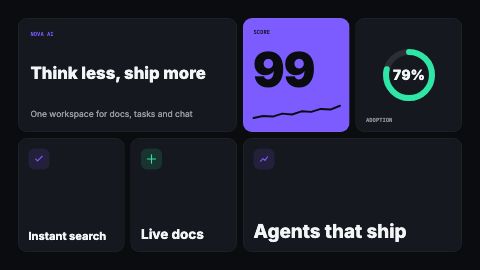
16:9 · 8s · Product launch
We tested 14 AI models across 84 real Remotion renders (product launch, kinetic typography, and animated data story) under one fixed contract. Here is what the measured reliability and cost numbers show.
100% free. Browse and edit every template without an account. No watermark, credit card, or attribution required. Free full-resolution MP4 downloads. Built for Claude Code, Codex, Cursor, Claude, and ChatGPT.
Four models rendered 6 out of 6 runs on the first try with zero repairs: Claude Sonnet 5.5 (57.1s avg, $0.093/video), GPT-6.1 Sol (135.5s avg, $0.077/video), Gemini 4 Argon (116.9s avg, $0.158/video), and Claude Opus 5.5 (194.0s avg, $0.236/video).
Claude Sonnet 5.5 was the fastest 100%-reliable model in the benchmark at 57.1 seconds average generation time per 12-second Remotion video, while GPT-6.1 Sol was the lowest-cost model in the 6/6 first-pass tier at $0.077 per run.
For high-volume iteration or prototyping, GPT-6 Luna rendered 6/6 runs (5/6 first pass) at $0.0057/video, Claude Haiku 5.5 passed 5/6 at $0.0079/video in 62.4s, and MiniMax M3.1 Flash rendered 6/6 (5/6 first pass) on its free endpoint.
Even reliable models take 1 to 3 minutes per draft and still need visual QA. Starting from a verified MIT-0 template on cliphou.se lets you personalize copy and colors in seconds, then export MP4 or hand the exact source code to your coding agent for deeper edits.
Every run, generated TSX file, error log, and measured cost from this summary is published with side-by-side video playback on the cliphou.se Motion Graphics Benchmark page at /benchmark/.
16:9 · 8s · Product launch

16:9 · 6s · Creator video
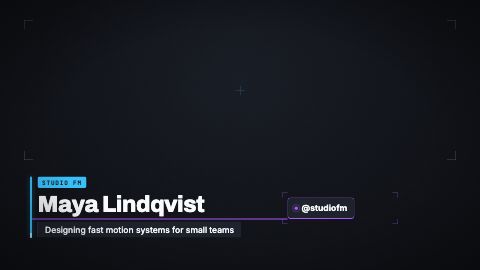
16:9 · 8s · Creator video

16:9 · 12s · Creator video

9:16 · 8s · Holiday sale
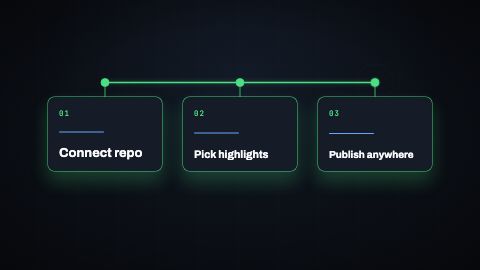
16:9 · 10s · Product launch